
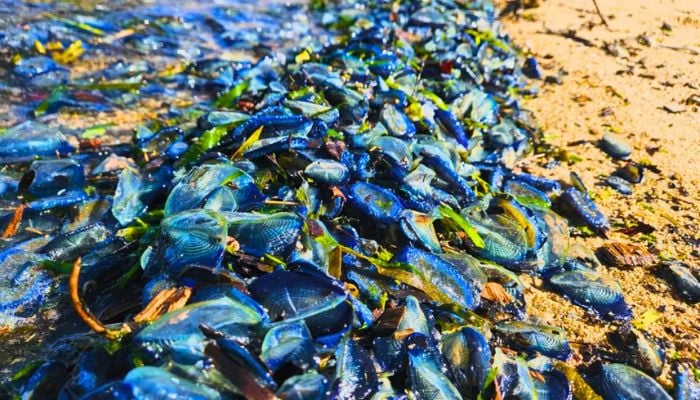
A coastline in Britain is found to be jeweled-up with rare beautiful blue sea creatures.
As reported, hundreds of “stunningly beautiful” blue sea creatures have washed up along parts of the Welsh coastline.
“Velella velella” commonly known as “by-the-wind sailors” and closely related to the Portuguese man o’ war, have been spotted on beaches across Anglesey, Gwynedd and Tenby.
A woman who found one of the free-floating hydrozoans on Tenby South beach said,” it was like a crystal.”
The nickname by-the-wind sailors comes from their small sail-like structure, which catches the wind and moves them across the ocean surface.
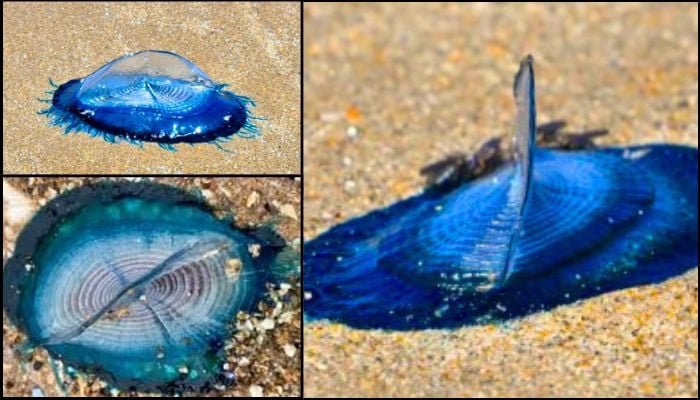
Marine specialist Frankie Hobro, of Anglesey Sea Zoo, said the creatures were beautiful but warned people not to touch them due to their sting.
Nature lover Maxine Allinson was walking on Tenby South beach on Tuesday when she spotted a by-the-wind sailor for the first time.
The 49-year-old said, “the view was fantastic and they are so beautiful.”
About 7cm long, they cannot move themselves and are often “dumped” ashore after storms or changes in currents.
“So you get the kind of blue tides of the by-the-wind sailors and obviously if they catch the sunlight as well it really sparkles,” she said.
“It’s stunningly beautiful and the Portuguese man o’war even more so because they have these kind of purples and pinks as well.”
Hobro said by-the-wind sailors were relatively common, usually appearing in autumn and winter when ocean currents carry them long distances.
Hobro said they were often mistaken for Portuguese man o’ war but were much smaller, “brighter blue” and “generally harmless”.
Similar to Portuguese man o’ war, by-the-wind sailors are colonies of animals related to sea anemones and corals, and they possess stinging cells.
Although their sting is generally considered “very mild” in comparison to Portuguese man o’ war, Hobro advised people not to touch them.
These are not true jellyfish, but “colonial hydroids”—a colony of tiny individual animals that work together. They are distinct for having a small, stiff “sail” on top of their body that catches the wind, allowing them to drift across the ocean surface.
They are often referred to as a “blue tide” when they wash up in large numbers.