
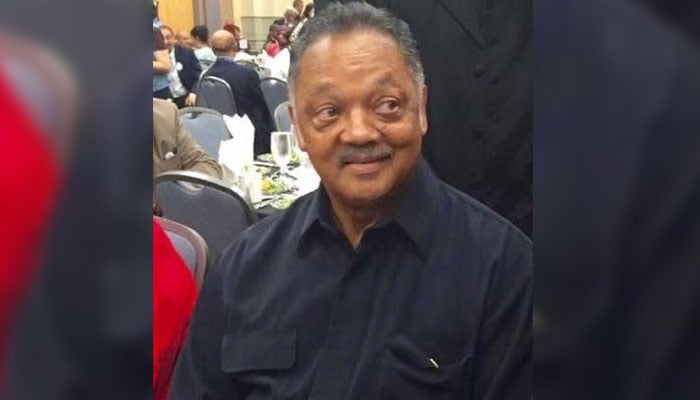
Reverend Jesse Louis Jackson Sr, a towering figure in American politics and one of the most enduring voices of the civil rights movement, has died at the age of 84.
With his passing, the US loses a leader whose voice echoed for more than six decades in defence of racial equality, economic justice and religious freedom.
Jackson, a notable figure of the American civil rights movement, was a close associate of Dr Martin Luther King Jr, and marched in historic demonstrations for voting rights and racial equality.
After Dr King’s assassination in 1968, when the movement stood at a crossroads, Jackson stepped forward to help carry its moral and political weight.
He founded Operation Push and later the Rainbow Push Coalition, organisations designed to expand economic opportunity and political participation for African Americans, Latinos, workers, the poor and other marginalised communities.
In 1984 and again in 1988, Jackson sought the Democratic nomination for president. Though he did not win the nomination, his campaigns reshaped the party’s political landscape and broadened the electorate.
Demonstrating that the pursuit of the presidency was not the exclusive domain of the political elite but a platform through which historically silenced voices could assert their place in American democracy, his rallying cry, “keep hope alive,” became more than a campaign slogan; it evolved into a moral declaration that hope itself was the lifeblood of democracy.
Jackson’s advocacy extended well beyond the African American community as he was a vocal supporter of Arab and Muslim American civil rights, particularly during moments of national tension.
In 2010, amid heated debate over the proposed Islamic community centre near Ground Zero in New York, he publicly defended the project, arguing that religious liberty was a foundational American principle that must not be compromised by fear. To restrict the rights of one faith, he warned, would erode the democratic tradition for all.
In 2011, speaking at a CAIR-Chicago gathering, he reaffirmed his solidarity with Muslim Americans and insisted that justice cannot be measured by religion.
In 2015, when proposals surfaced suggesting mandatory identification cards for Muslims and harsh rhetoric targeted refugees, Jackson joined Muslim demonstrators in suburban Chicago, cautioning that such policies echoed darker chapters of history. For him, civil rights meant defending any community confronted by prejudice or exclusion.
His engagement with Muslim Americans was also visible during the 2016 Democratic National Convention, where he commended American Muslims for their civic participation and emphasised their integral role in the nation’s democratic process, reinforcing his belief that democracy thrives only when all communities are fully represented.
Internationally, Jackson spoke out against apartheid in South Africa, negotiated for the release of prisoners and hostages in Cuba and the Middle East, and pressed corporate America to adopt policies promoting diversity and equal opportunity.
He was awarded the Presidential Medal of Freedom, yet his defining characteristic was not the honours he received but the moral courage he consistently displayed in confronting injustice.
Leaders across the US and around the world have described him as a symbol of human dignity, inclusion and perseverance. But perhaps his greatest legacy lies in his role as a bridge builder as he worked to weaken the barriers of race, religion and class, insisting that democracy is not merely majority rule but a promise of participation and equality for all who call the nation home.
Reflecting on his passing, local Muslim leaders said that the sense of loss is profound. The world, they noted, has lost another steadfast advocate for human rights, a voice that rose on behalf of the vulnerable and refused to yield to injustice.