
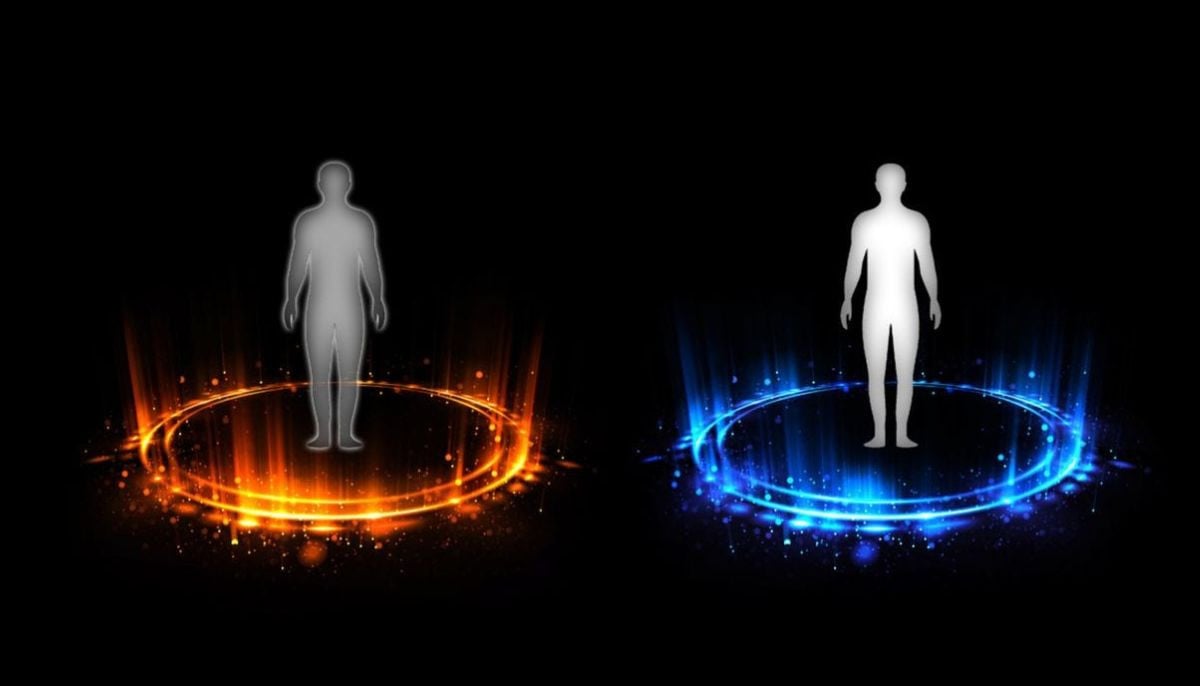
The dream of Star Trek-style instant travel has officially crossed the border from pure science fiction into a chilling philosophical reality.
Scientists at the University of Rochester and Purdue University have achieved a significant breakthrough in quantum mechanics, showing that teleportation has edged closer to reality, but at quantum level.
As per quantum teleportation, the researchers found it possible to transfer the quantum state of a particle to another distant particle through “entanglement” without moving any physical matter.
The entanglement-based phenomenon makes a link between distant particles regardless of distance.
Unlike sci-fi transporters popularized by Star Trek 60 years, which magically move the physical matter through destruction and reconstruction, quantum teleportation only transfers information between particles across the distance.
“Fundamentally, nature is quantum,”Jason Orcutt, a principal research scientist at IBM Quantum, said, “You are quantum information.”
Scientific progress
The first experiment took place in the late 1990s, demonstrating that quantum states could be transmitted only across shorter distances.
However, the subsequent research negated this concept by proving that quantum teleportation is also workable across longer distances, even to and from low Earth orbit.
In 2017, Chinese scientists achieved a milestone by successfully demonstrating teleportation between Earth and a satellite in orbit.
‘No-copying’ rule
In classic teleportation, you cannot transform the matter without destroying its originality. For instance if you want to send a document, you can scan it and send it to another person while keeping the original.
Unfortunately, in the world of quantum, “no-cloning theorem” prevents this, meaning one cannot create an identical copy of an unknown quantum state without destroying the original.
Implications for future science
While quantum teleportation will not lead to human travel, this breakthrough is the cornerstone for building a “quantum internet” and advanced quantum computers capable of solving problems that are impossible for today’s technology.
“There are problems that are very hard, the age of the universe hard, that we will not be able to solve with classical computing,” Orcutt said.
Even these quantum computers may one day simulate the molecular world along with complex chemical reactions with remarkable accuracy.
Consequently, this would help researchers to produce better fertilisers for agriculture and revolutionary new materials.
Can humans ever be teleported?
This technology offers little hope for human-based teleportation. When it comes to scaling this technology beyond particles to humans, this raises ethical concerns and existential questions. To worse, it stirs longstanding philosophical debate: Is the person who materializes out of thin air actually the same person, or a copy?
The destruction of original beings will give rise to a dilemma defined by a society where duplicate human copies would roam freely.
Orcutt explained, “That’s all built entirely on speculation,” “For now, the question of whether you can teleport a human, let alone an atom, exists squarely within the realm of science fiction—and so does any answer to that question.”
Although the concept of teleportation seems interesting, it also comes with a haunting question: Is the convenience of instantaneous travel worth sacrificing our fundamental sense of self?