
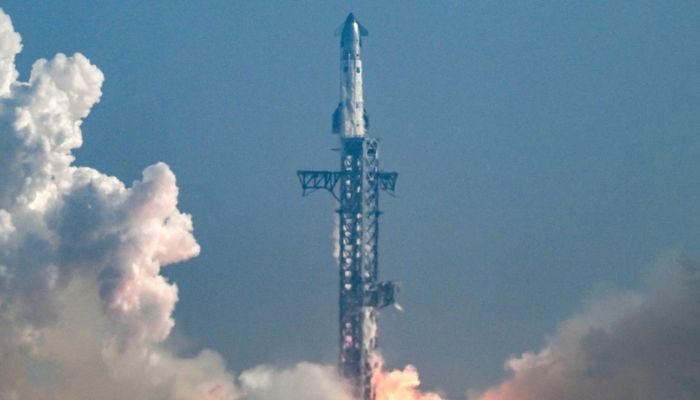
On Monday, the US Federal Aviation Administration took a significant step by closing its review into a SpaceX Starship’s booster malfunction that occurred during a test flight last month, paving the way for SpaceX to officially launch the rocket’s next test flight from Texas.
The test flight of SpaceX’s Starship rocket launched on May 22 marked the 12th test since 2023. This new version is anticipated to be the focal point of Musk’s launch business, satellite ambitions and efforts to put astronauts on the moon.
After the Starship upper stage accelerated into space on a non-orbital flight that ended up in the Indian Ocean, the Super Heavy booster made an unsuccessful attempt to execute a controlled soft landing in the Gulf of Mexico.
Notably, SpaceX has made procedural alterations to address the interconnected causes. In this connection, the FAA said: “Erroneous engine alarm system settings also contributed to the return failure, and Super Heavy plunged into the Gulf of Mexico at high speed.”
The company is gearing up for another Starship test launch from its Starbase facility in Texas on Thursday. Similarly, like the last flight, SpaceX hopes to return Super Heavy to the Gulf of Mexico waters and the Starship spacecraft to the Indian Ocean after a roughly hour-long flight through suborbital space.
For the first time, the 13th Starship flight will deploy actual Starlink V3 satellites, building on previous tests that focused on validating orbital positioning and deployment mechanisms.
SpaceX is all set to roll out Starlink V3 satellites aboard launch vehicles by the end of this year-a long -awaited breakthrough as the program has fallen years behind Musk’s initially projected timelines despite over $15 billion in crucial spending on the rocket’s development to date.