
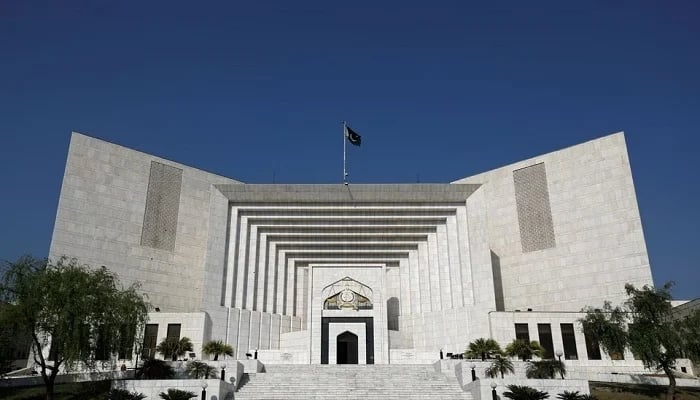
- Quran, Hadith stress justice, integrity and accountability: SC.
- Public trust is judiciary’s foundation, SC observes in judgment.
- Adds judiciary draws strength from credibility, not force.
ISLAMABAD: The Supreme Court (SC) has observed that a judge’s integrity extends beyond simply avoiding allegations of corruption, stressing that a judicial officer must uphold an unblemished character, exemplary conduct, and a respectable reputation in society.
A three-member bench of the court, headed by Justice Shahid Waheed, and comprising Justice Naeem Akhtar Afghan and Justice Muhammad Shafi Siddiqui, issued a detailed judgment in the case concerning the dismissal of former Additional District and Sessions Judge Afzal Zahid, who was posted in tehsil Mailsi, Punjab, The News reported.
Justice Shahid Waheed authored the judgment.
The court held that the standard for a judge is not mere innocence, but being above all suspicion. “A judge’s integrity cannot be divided; it is either complete or non-existent,” the court held, adding that the judiciary stands not on force but on public trust; if that trust is damaged, a judge cannot be retained in office.
The court heard appeals on May 13, 2026 filed in a case regarding the dismissal of a former Additional District and Sessions Judge of Mailsi, Afzal Zahid.
“If a judge’s credibility and reputation are damaged, keeping such a person in office is tantamount to undermining judicial ethics and public trust,” says a nine-page judgment, authored by Justice Waheed.
The court held that a judge’s integrity is not tarnished only by proven corruption; a bad reputation alone can also darken the dignity of the judiciary.
The judgment observed that people do not come to courts merely to argue laws; they come to hear the voice of a human conscience sitting in the robe of a judge.
“If that conscience becomes doubtful, the entire system of law becomes questionable,” says the judgment, adding that the judiciary derives its strength not from guns or the military, but from public credibility and moral authority.
The court held that granting “compulsory retirement” with benefits to a judge with a bad reputation creates the impression that reputation and integrity in the judiciary can be negotiated, which amounts to mocking the law.
“When a corrupt or disreputable judge is dismissed from service, the judicial institution effectively removes a “cancerous tumour” from its body, initiating its healing process”, says the judgment.
Referring in detail to the Quran, Hadith, and Islamic jurisprudence, the judgment stressed that the office of a judge in Islam is not merely a job but a sacred trust and an act of worship.
The court cited Surah An-Nisa (verse 58), which commands that trusts be returned to their rightful owners and that judgments be made with justice. It also quoted a well-known Hadith stating that judges are of two kinds: one destined for Paradise (who recognise the truth and decide accordingly), and the other destined for Hell (who decide with ignorance or injustice).
The court further held that along with knowledge, piety, and integrity are essential. Citing principles of great Islamic jurists such as Imam al-Mawardi and Ibn Qudamah, it was noted that if doubts arise in the public mind about a judge’s integrity due to his character, it becomes obligatory to remove him immediately.
Retaining an incompetent or disreputable person as a judge amounts to a breach of trust against God, His Messenger, and the Muslim Ummah.
The court held that the institution requires not only actual integrity but also the perception of integrity.
Multiple complaints had been received against the former additional district and sessions judge regarding corruption allegations, following which the Lahore High Court ordered his supervision. In the quarterly reports prepared under this supervision, his reputation was found to be tainted.
Although a departmental inquiry could not directly prove allegations of corruption against him, the competent authority dismissed him from service on the basis of his poor reputation and questionable integrity.
On appeal, the Service Tribunal converted his dismissal into compulsory retirement. Against this, the Lahore High Court, through its Registrar, filed an appeal, while the judge concerned also filed an appeal seeking reinstatement and removal of adverse remarks.