
The equity market came under renewed pressure on Monday as investors stayed wary of escalating US-Iran tensions, while the start of the roll-over period added to intraday volatility and kept risk appetite subdued.
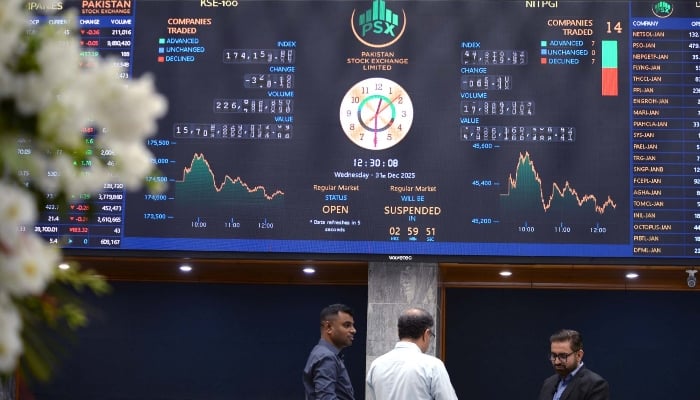
The Pakistan Stock Exchange’s (PSX) benchmark KSE-100 Index traded between a high of 174,336.85 (up 1,167.14 points, or 0.67%) and a low of 169,071.03 (down 4,098.68 points, or -2.31%) compared to the previous close of 173,169.71.
“The market remained under sustained pressure, as investors stayed wary of escalating geopolitical tensions between the United States and Iran, prompting cautious positioning,” said Huzaifa Riaz, Director, Mayari Securities (Pvt) Limited.
“The absence of any meaningful near-term trigger, coupled with the commencement of the roll-over period, further contributed to volatility, keeping the bias lower,” he added.
US President Donald Trump said on Thursday he would decide in “10 or 15 days” whether to order strikes on Iran if no nuclear deal is reached, while Axios reported he was presented with military options that included a direct attack on Iran’s supreme leader, Ayatollah Ali Khamenei.
The United States and Iran have held two rounds of indirect talks in Oman and Switzerland, with talks set to resume Thursday in Switzerland, though the two sides’ positions have yet to converge.
Pakistan’s profit and dividend repatriation by foreign investors rose to $1.677 billion in 7MFY26 from $1.328 billion a year earlier, according to the State Bank of Pakistan (SBP). In January, repatriation stood at $118.9 million, with analysts pointing to a broader normalisation of capital outflows alongside improved reserves and a stabilising external account.
Pakistan posted a current account surplus of $121 million in January on strong remittances and lower imports, but the cumulative position showed a $1.07 billion deficit in 7MFY26, compared with a $564 million surplus a year earlier, reflecting import normalisation as activity recovers and export growth stays moderate.
SBP data also showed the power sector recorded the largest increase in repatriated earnings, followed by notable inflows in the financial sector.
Weekly inflation, measured by the Sensitive Price Indicator (SPI), increased 1.16% for the combined consumption group in the week ended February 19, the Pakistan Bureau of Statistics (PBS) reported.
The SPI rose to 335.67 points from 331.81 a week earlier, while YoY SPI inflation came in at 5.19%. The SPI increased across all consumption groups, including 1.11% for the lowest bracket (up to Rs17,732) to 325.8 points.
In the previous session on Friday, the KSE-100 gained 999.42 points (0.58%) to close at 173,169.71, after trading between 174,148.33 and 169,592.53.