
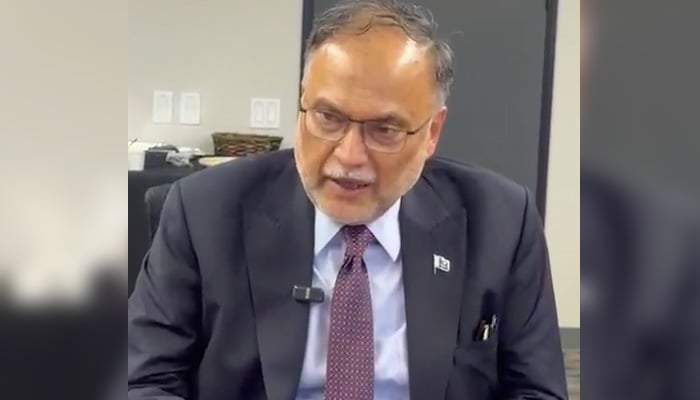
HOUSTON: Federal Minister for Planning, Development and Special Initiatives Ahsan Iqbal has said that no form of hybrid system currently exists in Pakistan, and that all state institutions are working in one direction for national interest and shared national goals.
He made these remarks while talking to Pakistani media in Houston, following an event hosted by the Pakistan Consulate and community leader Tahir Javed.
The federal minister said the existing institutional harmony is Pakistan’s strength, and it is because of this that the country has achieved important successes on the diplomatic, defence and economic fronts.
Responding to a question about the hybrid system, Iqbal said Pakistan could not afford internal confrontation or a tug-of-war between institutions at this time. “If there is complete harmony between the political leadership and state institutions, this is not a weakness but Pakistan’s strength, the positive results of which the world has seen in the diplomatic and economic spheres.”
On a question about the creation of new provinces, he criticised the system of devolving powers to the provinces following the 18th Constitutional Amendment, saying that although powers were transferred from the federation to the provinces, the provinces had not passed them down to the grassroots level.
According to him, the improvement expected in education, health and other social sectors over the past 15 years had not materialised, because within the provinces too, powers remained confined to a few centres.
The minister proposed that around 160 empowered district governments be established across the four provinces so that the public could be provided better services at the local level. “It is not administratively possible to effectively run the whole of Sindh from Karachi, the entire Punjab from Lahore, Khyber Pakhtunkhwa from Peshawar, and the whole of Balochistan from Quetta; and that genuine devolution of powers down to the district level is therefore necessary.”
He warned that “if this is not done, demands for new provinces could intensify in future”.
Iqbal described his recent visit to the United States as extremely beneficial for Pakistan, saying that although it was a private visit, it was used in the national interest.
He said important meetings were held with Silicon Valley technology companies, artificial intelligence experts and leading academic institutions, in which agreement was reached on promoting AI, startups, research and modern education in Pakistan.
He said positive progress was also made with institutions including the University of Illinois Chicago, Illinois Institute of Technology, the University of Chicago and Cornell University on expanding cooperation in robotic surgery, higher education, and under the US-Pakistan Knowledge Corridor.
On a question about the ruling coalition — including a specific query on whether the MQM-P is really planning to part ways with the PML-N-led government — Iqbal said minor differences occur in every coalition government, “but the current alliance faces no threat”.
He added that all allied parties are aware of the gravity of the country’s problems and are working together in the national interest.
According to him, whenever any ally has a grievance, the prime minister moves promptly to address it.
The federal minister also expressed hope that Pakistan would move forward as a strong, prosperous and self-reliant state through political stability, institutional harmony, devolution of power to the grassroots level, modern technology, education and global partnerships.
The Pakistan-US relations, he said, should no longer be confined to security and geopolitics alone, adding that in the past, relations between the two countries had largely depended on geopolitical circumstances — ties strengthened when interests aligned, and distance grew when circumstances changed.
He said that in future, the relationship could be broadened into a durable and stable partnership by expanding cooperation in geoeconomics, trade, investment, education, research, artificial intelligence, innovation and technology.
He said positive progress has also been made on expanding educational cooperation with American universities. “Discussions are held with the University of Illinois Chicago on cooperation in robotic surgery, with the Illinois Institute of Technology on establishing a campus in Pakistan, and with the University of Chicago, Cornell University and other institutions on providing more Pakistani students with higher education opportunities under the US-Pakistan Knowledge Corridor, to which the institutions concerned responded positively.”
Giving details of his visit to Nasa in Houston, the federal minister said space technology is of great importance for Pakistan given the risks it faces from climate change. He said discussions were held with the US space centre on gaining knowledge to promote space education and space exploration at the school level in Pakistan, so that children could be introduced from an early age to the mysteries of the universe, the various observations made within it, and humanity’s exploration of space.
Pakistan has made notable progress in its space programme, having launched four satellites over the past two years.
He said Suparco has been given the target of making Pakistan’s lunar mission successful by 2035. He said space technology would also play a crucial role in tackling challenges such as climate change.
The agreement, he went on to say, was reached with US space agencies and experts in Houston on promoting space education at the school level, in order to cultivate an interest in science and space research among the new generation.
Iqbal said the Holy Quran invites man to reflect upon the universe, and that “Muslims therefore need to revive the tradition of scientific research and knowledge”.
“If the new generation is connected to science, space research and modern technology from childhood, Pakistan could achieve a prominent position in the fields of knowledge and science in the future.”
Iqbal added that Pakistan’s recent diplomatic, economic and defence successes had enhanced the country’s standing at the global level. He said economic stability had increased the international financial community’s confidence in Pakistan, while the world had recognised Pakistan’s defence capabilities following the success of Marka-e-Haq. He said Pakistan’s effective diplomacy in promoting peace in the region has also had a positive impact on the national economy.
The minister further said that to make these gains sustainable, full attention now needs to be focused on strengthening the economy and increasing exports.
He added that the government’s top priority is to make Pakistan self-reliant through exports, since reliance on the IMF and other external financial institutions could not be ended until the country significantly increased its capacity to earn foreign exchange.
Urging the diaspora to play an active role in promoting Pakistani products around the world, he said: “Every overseas Pakistani should become an economic ambassador for their country, introducing Pakistani products to new markets, marketing them, and helping increase exports, as this will prove to be an important step toward Pakistan’s economic self-determination.”
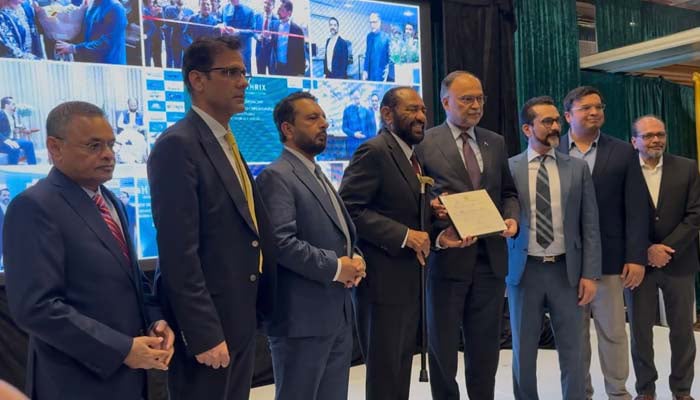
The federal minister, while addressing a reception hosted in his honour by the Pakistan Consulate in Houston, urged overseas Pakistanis to promote a positive image of Pakistan abroad and play a role as unofficial ambassadors of their homeland.
The event was also addressed by US Congressman Al Green, Pakistan’s Consul General Chaudhry Aftab, Democratic leader Tahir Javed and other prominent figures. While Ibrahim Javed moderated the event
He said that Pakistanis living abroad can best represent Pakistan around the world and instead of taking political differences abroad, they should play their role in promoting Pakistan’s development, investment, trade, education and technology.
Iqbal said that overseas Pakistanis are a valuable asset of Pakistan and their services have been significant in the development of different countries of the world. He said that now is the time to utilise this same ability, experience and expertise for Pakistan’s economic development, scientific progress and national prosperity.
Congressman Green said that Pakistan played its role in promoting peace in difficult circumstances, which should be seen with appreciation.
He said that making the world more secure and peaceful by reducing differences is the need of the hour, and the countries that play a practical role for this purpose deserve the respect of the international community.
Al Green, while appreciating the services of the Pakistani community, said that America is a better country because the Pakistani community is playing a positive role in its development. He expressed his best wishes to the Pakistani people and leadership and said that peace, mutual cooperation and common development are the guarantee of a bright future for both countries. On this occasion, Congressman Al Green presented the Federal Minister with a certificate of congratulations from Congress.