
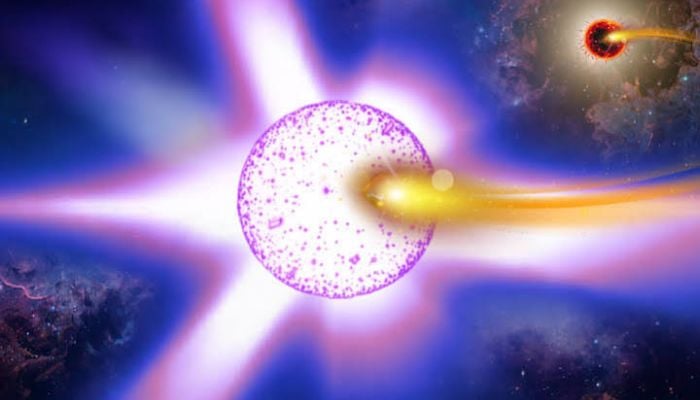
The phoenix, which was considered a mythical bird with an eternal cycle of life and death, has now inspired the name for a world dubbed a “phoenix planet” by astronomers.
According to researchers, this exoplanet as planets across our solar system are called appears to have been born from material expelled into space during the stellar outflow of a star bigger than the sun and now orbits the compact companion left behind called a white dwarf.
The white dwarf is located about 250-light years from Earth with a distance traveled in a year around 5.9 trillion miles. Primarily, the planet is a gas giant more massive than Jupiter around our solar system.
It orbits the white dwarf every 4.4 days at a distance of 4% of that between Earth and the sun. This is so close that the blazingly hot white dwarf’s extreme ultraviolet radiation is causing the planet’s outer atmosphere to strip away with a portion then falling onto the dwarf.
Researchers with the help of data from the Hubble, TESS and FUSE telescopes hope to use the James Webb Space Telescope to validate their findings.
In this connection, Jamie Williams, a doctoral student in astrophysics said: “In myths, a phoenix is born again from its own ashes. In the case of this planet, it is born again from the ashes of its dying host star, and therefore the planetary system is reborn. A second-generation planet is defined as one born after its host star dies — in this case after it has become a white dwarf.”
“White dwarfs are much more common than pulsars, and over 95% of stars in the Milky Way will evolve to become a white dwarf. Therefore, there would be many more second-generation planets around white dwarfs than around pulsars.”
“If a gas giant formed around a white dwarf, then a rocky planet could form, too. White dwarfs cool predictably over time and as they get cooler, their cooling slows. So if a second-generation rocky planet formed close enough to the white dwarf then it could remain in the habitable zone for billions of years.”
The use of the Zwicky Transient Facility at Palomar Observatory in California was used to discover a red dwarf star about 8% of the mass of the sun in a tight orbit with a brown dwarf.
It is crucial to note that these two bodies orbit each other every 87 minutes at a distance just beyond the midpoint between Earth and the moon as the star gravitationally strips matter from the brown dwarf; though researchers detected a hot spot on the star’s surface where this material appears to be accumulating.