
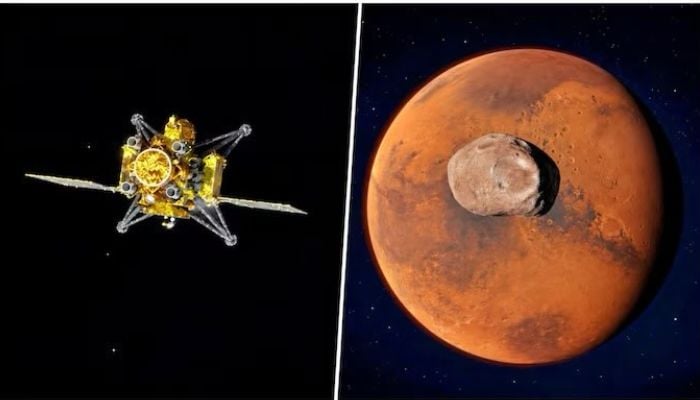
Japan is set to launch a spacecraft on the world’s first mission to bring back samples from the Phobos-a potato-shaped moon revolving around Mars.
Scientists expect that the mission will take five years, providing a deeper and more analytical understanding of how Phobos and its smaller sibling Deimos provide insight into the origins of life in the solar system.
The Japan Aerospace Exploration Agency is working to launch the spacecraft on Tuesday on a new Japanese mainstay H3 rocket.
Phobos and Deimos derived their names from the Greek mythological epitomes of fear and terror whose Roman counterpart is Mars. Some scientists think the debris formed after a large celestial object crashed into Mars.
Scientists prefer to collect samples from Phobos mainly because the moon is closer to Mars than Deimos and therefore might hold deeper insights about the planet. Jaxa officials said that material from Mars is anticipated to account up about 0.1% of the material collected from Phobos.
Following launch on the H3 rocket, the spacecraft will arrive at Mars region in August 2027, to fly near Phobos for three years to retrieve Martian moon information and physical samples ahead of the 2031 return mission.
The spacecraft will specifically carry 13 instruments, including a rover jointly developed by France and Germany that will land on the moon alongside with a NASA sampling device and an instrument to measure gamma rays.
The collection of samples from multiple geographic locations optimizes the likelihood of retrieving potential evidence of past microbial life on Mars. In addition, the samples will be stored in a heat-protected capsule built to survive the return from orbit.