
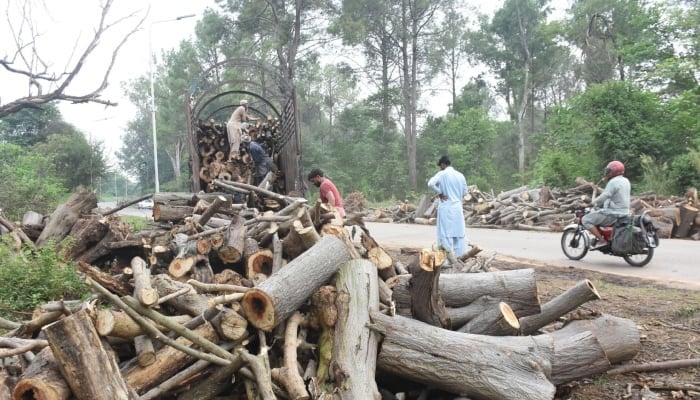
- CDA says it is bound to ensure 8% green area in Islamabad.
- Tells IHC that greenery in federal capital is above required standard.
- Maintains trees chopped as per guidelines of SC-appointed experts.
ISLAMABAD: Amid prevailing concerns over a tree-cutting drive in the federal capital, the Capital Development Authority (CDA) on Tuesday told the Islamabad High Court (IHC) that paper mulberry trees in Islamabad were being chopped down on the directives of the Prime Minister’s Office (PMO).
Submitting its response in a case related to the cutting of trees in Islamabad, the CDA said that changes to the master plan fall under the authority of the federal government and that the plan has been amended several times with official approval.
“Under the planning parametres, the CDA is bound to ensure an 8% green area,” the authority said, adding that greenery in the federal capital exceeds the required standard.
The CDA’s tree-cutting drive in the capital has sparked widespread debate in recent days, and has also become a point of contention within the ruling coalition, as several political parties and civil society groups have expressed concern over the removal of trees.
The Islamabad district administration had, in January, said the campaign was specifically targeting paper mulberry trees, maintaining that the species was responsible for serious health problems in the city.
The CDA, in over a year, has also removed nearly 30,000 paper mulberry trees, including 8,700 allergy-causing trees in the city to mitigate the intensity of pollen allergy.
Last month, the IHC suspended the CDA’s tree-cutting drive and sought a clause-wise reply and a detailed report from all parties.
Addressing the issue, Minister of State for Interior Talal Chaudhry has said that only allergy-causing paper mulberry trees were removed and that 60,000 new trees would be planted by the end of March, in addition to more than 40,000 mature trees already planted.
Meanwhile, in its response to the IHC, the CDA maintained that paper mulberry trees were removed because they cause pollen allergies.
“Scientific research has established that paper mulberry triggers asthma and other allergic reactions,” the authority said.
“Harmful paper mulberry trees have been cut and environmentally friendly trees have been planted,” the CDA said, while stressing that the paper mulberry species does not help prevent pollution and instead contributes to the deterioration of the air quality index (AQI).
Recalling that the IHC in 2022 had ordered the formation of an environment committee comprising relevant stakeholders, the CDA said the committee in 2023 had decided to cut down paper mulberry trees and replace them with environment-friendly species.
“The paper mulberry trees were removed in line with the recommendations of Supreme Court-appointed experts,” the authority said in its reply.
The CDA further said the PMO had taken notice of a column written by journalist Saleem Safi in 2024 and had directed the Ministry of Health and the CDA to take preventive measures to address the pollen issue.
Highlighting that a large stretch along the Islamabad Highway is covered with paper mulberry trees, the CDA said the federal government has approved the construction of a monument commemorating “Marka-e-Haq” — the country’s May 2025 armed conflict with India — in Islamabad’s DHA Phase-VIII.
It added that the land has been transferred to the Ministry of Planning and Development and that plants located there were shifted to other areas, including Shakarparian.
Pollen issue
The federal government, as reported by The News, initiated a comprehensive campaign in last quarter of 2024 to address the long-standing issue of seasonal pollen allergies within the Islamabad Capital Territory (ICT).
This effort, focusing on the systematic management of allergenic trees, was launched in response to a high-level directive from the prime minister, who designated the pollen issue a priority agenda.
A clear roadmap for action was established following a high-level meeting on November 27, 2024, chaired by Dr Mukhtar Ahmad Malik, Minister of State for National Health Services, Regulations, and Coordination.
Under this directive, the CDA was tasked with executing a detailed plan for the removal of allergenic species, specifically the paper mulberry tree, and providing regular progress reports to ensure the mitigation of this severe health challenge.
The Health Ministry, in collaboration with the CDA, employed a rigorous scientific three-step process to ensure the complete eradication of the allergenic species. This methodology involved cutting the trees, uprooting the entire root system, and refilling the soil to prevent any future regrowth.
This systematic approach resulted in the removal of 29,115 allergenic paper mulberry trees across the Capital. It is to be noted that the eradication protocol was applied exclusively to the invasive Broussonetia papyrifera (paper mulberry).
No indigenous or non-allergenic tree species were disturbed during this campaign, and the subsequent restoration efforts focus solely on the replacement of the uprooted paper mulberry units in designated areas.
The eradication drive was implemented across major sectors and green areas of the Capital. Large-scale removal was carried out in F-9 Park (12,800 trees) and Shakarparian (8,700 trees). In urban sectors, 2,965 paper mulberry trees were cleared from G-10, G-11, F-10, F-11, D-12, and along Srinagar Highway, while additional removals included 1,405 trees in G-8, 839 in G-9, 490 in F-8, 1,142 in H-8, and 534 in H-9.
This targeted operation ensured effective coverage of both high-density urban areas and major recreational zones.
Following the successful removal phase, the campaign has now transitioned into an ambitious and sustainable green restoration strategy.
To maintain and enhance the city’s environment, the government has mandated that for every allergenic tree removed, three new environment-friendly, indigenous trees must be planted, the CDA official said.
In line with this policy, 40,000 indigenous and environment-friendly large trees have already been planted on sites cleared for paper mulberry. This replantation effort includes a diverse mix of fruit-bearing and pine species to ensure a healthier ecosystem.
In Shakarparian alone, 81 acres of land across three sites have been levelled and prepared, with pit-digging currently underway for the upcoming planting season.
The entire project, from eradication to final replantation, will be concluded by the end of April 2026. Statistical data from the Allergy Centre Islamabad confirms that this intervention has led to a substantial improvement in the masses’ health.