
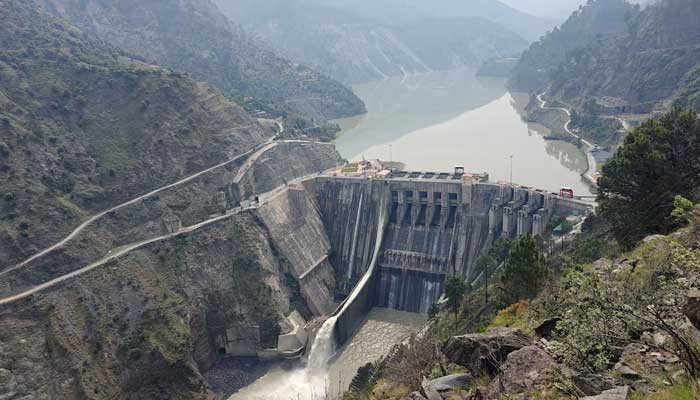
- India’s centrepiece is 1,856MW Sawalkote Hydropower Project.
- Run-of-the-river initiative will include a 192.5-metre-high dam.
- Project signals India’s intent to assert control over Pakistan’s rivers.
ISLAMABAD: In a move termed by Pakistan as a deliberate “weaponisation of water,” India has fast-tracked massive hydropower projects on the Chenab River, escalating tensions over the decades-old Indus Waters Treaty (IWT) of 1960, The News reported on Tuesday.
Officials say New Delhi is aggressively manipulating river flows while building some of the largest dams in the disputed region of Jammu and Kashmir.
According to highly placed sources, the centrepiece of India’s push is the 1,856 megawatts Sawalkote Hydropower Project, which received environmental clearance in October 2025.
Located in the Ramban district, this run-of-the-river project will include a 192.5-metre-high dam and an underground powerhouse capable of generating 8,000 million units of electricity annually.
Stage I will feature six 225MW units and one 56MW unit, followed by two additional 225MW units in Stage II. The project covers 1,401 hectares, including 847 hectares of forest land, and will displace local communities.
The Sawalkote project, initially approved in 2017, gained momentum in 2025 following India’s controversial announcement to hold the IWT in abeyance — a move Pakistan rejected as illegal and provocative.
Analysts warn that the project, along with other mega-schemes, signals India’s intent to assert control over rivers allocated to Pakistan under the treaty.
India has also approved the 260 MW Dulhasti Stage-II Hydropower Project in the Kishtwar district, increasing pressure on Pakistan’s share of Chenab waters.
Existing operational projects on the Chenab include Dulhasti-I (390 MW), Baglihar I & II (890 MW), and Salal (690 MW), while Ratle (850 MW), Kiru (624 MW), and Kwar (540 MW) are under construction.
Other major schemes — including Bursar, Pakal Dul, and Kirthai I & II — are in planning or fast-tracking stages.
During the ongoing winter season, India deliberately manipulated river flows, releasing 58,000 cusecs at Head Marala on December 7–8, 2025, before sharply reducing flows to 870–1,000 cusecs on December 13–17.
Historical flows for this period typically range between 4,000 and 10,000 cusecs, officials stated.
Pakistan maintains that India violated the IWT by emptying and refilling the Baglihar reservoir — an action previously condemned by the Court of Arbitration on August 8, 2025 as constituting weaponisation of water.
Pakistan’s Commissioner for Indus Waters, Syed Mehr Ali Shah, confirmed he has formally notified India, citing scientific evidence of deliberate water manipulation and invoking Articles VI and VIII of the treaty to demand immediate consultations.
The tensions trace back to April 23, 2024, when India unilaterally announced it was holding the treaty in abeyance. Pakistan’s National Security Committee, chaired by Prime Minister Shehbaz Sharif, strongly rejected the move, warning that any attempt to block or divert Pakistan’s waters would be considered an act of war.
With mega-dams, manipulated flows, and rising tensions, the Chenab River has become the latest flashpoint in one of South Asia’s most critical water disputes — raising fears of both environmental and geopolitical fallout in the months ahead.
IWT between Pakistan and India
The nuclear-armed neighbours disagree over the use of the water from rivers that flow downstream from India into the Indus River basin in Pakistan.
The use of the water is governed by the Indus Waters Treaty, which was mediated by the World Bank and signed by the neighbours in September 1960.
The agreement split the Indus and its tributaries between the two countries and regulated water sharing. India was granted the use of water from three eastern rivers — Sutlej, Beas and Ravi — while Pakistan was granted most of the three western rivers — Indus, Jhelum and Chenab.
There is no provision in the treaty for either country to unilaterally suspend or terminate the pact, which has clear dispute resolution systems.
The countries have argued over and disputed several projects on the Indus and its tributaries for years.
Pakistan is heavily dependent on water from this river system for its hydropower and irrigation needs.
Pakistan says India unfairly diverts water with the upstream construction of barrages and dams, a charge India denies.
Pakistan is concerned that India’s dams will cut flows on the river, which feeds 80% of its irrigated agriculture. It has asked for a neutral expert and then an arbitration court to intervene in two recent hydropower projects.
However, New Delhi’s announcement to hold the IWT in abeyance means it can stop sharing crucial information and data on the release of water from barrages/dams or on flooding, Indian officials said, adding that India will also not be obliged to release minimum amounts of water during the lean season.