
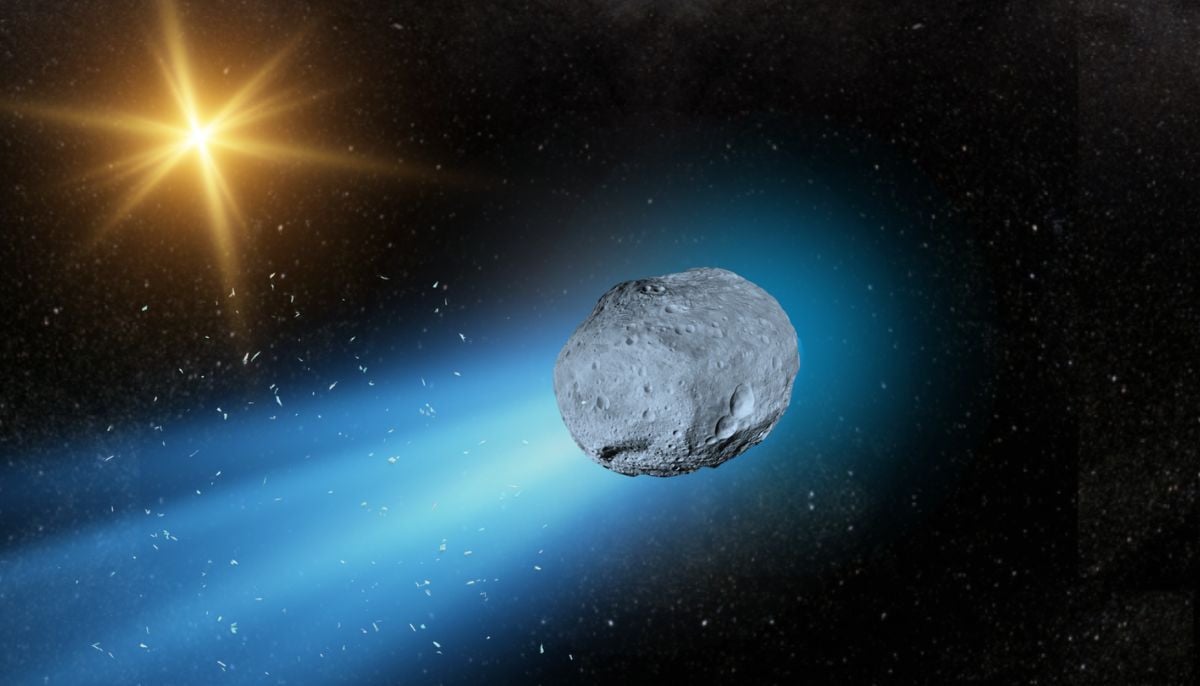
An interstellar comet older than our solar system is releasing water vapour at a rate equivalent to 70 Olympic swimming pools every day, and scientists say it may be the most valuable planetary defence lesson they have received in years.
The comet 3I/ATLAS was discovered on 1 July 2025 and has since become the subject of some of the most unusual tracking work in ESA’s history.
What makes comet 3I/ATLAS different from any comet before it?
Comet 3I/ATLAS did not form here. It originated somewhere in the distant reaches of the Milky Way and is estimated to be at least 7 billion years old and possibly 10 billion, making it the oldest comet ever identified.
It is passing through our solar system once and will never return, which gave scientists a narrow window in which to study it.
The space comet 3I/ATLAS reached its closest point to the Sun in late October 2025, which resulted in the spacecraft receiving an intense solar energy burst.
The heat caused ice within the comet’s nucleus to sublimate into water vapour, which created the exceptional outgassing rate that scientists observed during ESA’s Juice spacecraft camera observation of the comet in early November.
The Jupiter Icy Moons Explorer, Juice, is currently travelling through the solar system to reach its destination at Jupiter, which will occur in July 2031.
The mission’s main objective is to study Europa, Ganymede and Callisto because scientists think these moons have buried liquid oceans that exist under their ice-covered surfaces.
The Juice science team used the spacecraft NavCam system to observe 3I/ATLAS because it provided them with better close-up images which Earth-based telescopes could not match. Juice had the ability to detect the comet because it appeared during a period when Earth observers could not see it.
The Planetary Defence team of ESA used NavCam images, which they gathered during November 2025, to track the comet’s position changes and improve their trajectory calculations.
That tracking capability is the finding that has defence planners paying attention. Many potentially hazardous asteroids are too distant and too faintly lit to be detected from Earth until they are already on approach.
Juice’s observations of 3I/ATLAS demonstrate that deep-space probes already operating in the outer Solar System could serve as advanced early warning sensors able to calculate the orbits of threatening objects long before any ground-based telescope could confirm their existence.