
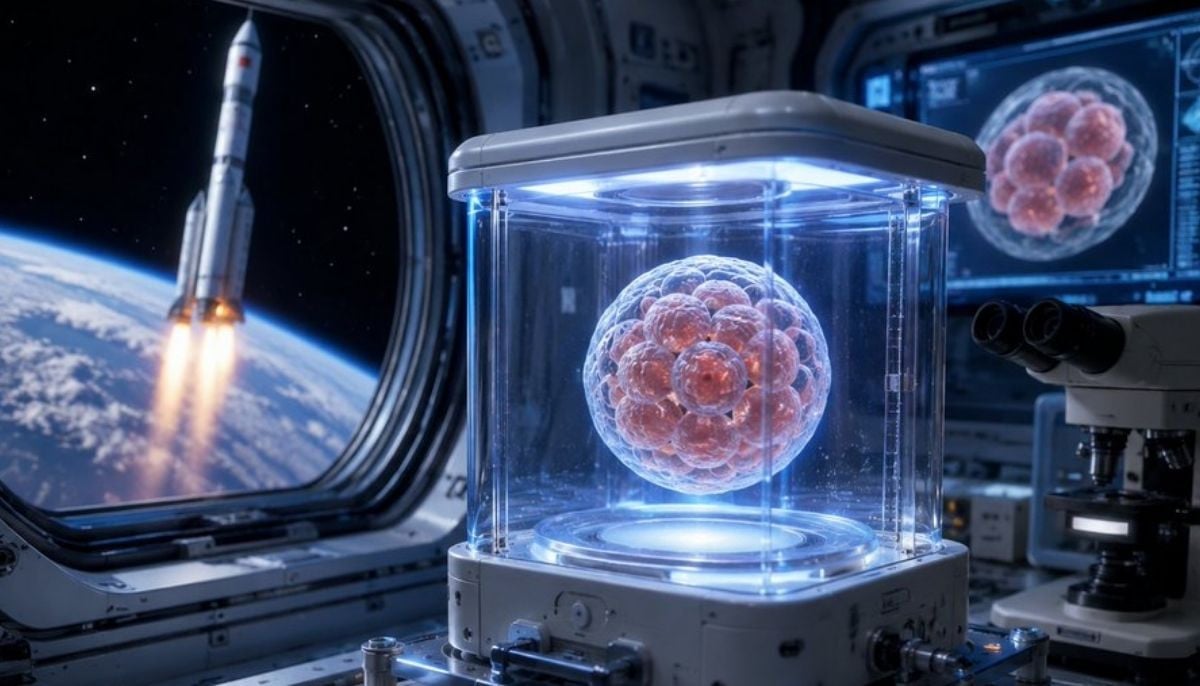
China in a first-of-its-kind experiment has sent “artificial human embryos” to space, aiming to learn more about how microgravity affects human reproduction and paving a way towards “space babies” development in future.
With this milestone, China has also become the first nation to even conduct such a historic experiment. If proven successful, the implications could be bigger as Beijing is also looking to establish self-sustaining colonies on the Moon and Mars.
According to state officials, these embryo-like structures are made from living human stem cells. They were sent into orbit as a part of the Tianzhou-10 resupply mission and arrived on the Tiangong space station in the early hours of May 11.
The purpose of the experiment conducted by researchers from the Chinese Academy of Sciences, is to find out the effects of microgravity on early human embryonic development.
“This is not a real human embryo and does not have the ability to develop into an individual,” Leqian Yu, a researcher at the Chinese Academy of Sciences’ (CAS) Institute of Zoology who is leading the experiment, said.
“However, it can serve as a model for studying early human development.”
During the experimental phase, the researchers will study two different types of embryo phases. The first phase consists of a pre-implantation model which resembles the uterine wall where embryos would attach themselves.
The second phase includes a peri-gastrulation model, replicating the process where cells reorganize into tissue and organ layers.
For robust comparison, the researchers have also grown and frozen identical artificial embryos on Earth as a control group.
“We hope that by comparing the development of space and ground samples, we can identify the factors affecting early human embryonic growth in the space environment, and address the risks and challenges humans may face during long-term space habitation,” Yu said.
The idea of making human reproduction possible in space is not new. The concept is gaining momentum as the tech moguls such as Elon Musk and companies have been looking for expanding human civilization beyond Earth.
In March, scientists at Adelaide University tested human and mouse sperm in simulated space conditions to find out if sperm would struggle to “navigate” during sex in space.
According to findings published in the journal Communications Biology, some sperm showed resilience while navigating the challenging conditions, thereby raising hopes for conceiving children in space.
But the study also faced significant challenges marked by a 30 percent drop in successful fertilization rates. Because without Earth gravity, embryo development started losing quality.
The study found out that protecting embryos from weightlessness during the “critical first hours” will be essential for successful reproduction on the Moon or Mars.