
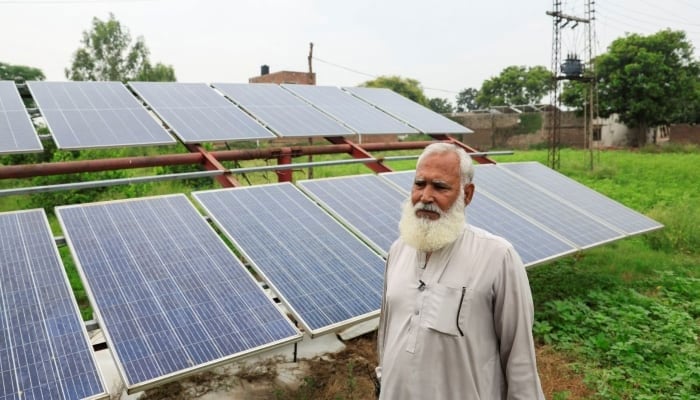
- 80-85% prosumers to be able to sell electricity at Rs25.32 per unit.
- New rooftop solar consumers to be placed on net billing mechanism.
- Will sell electricity to grid at Rs10-11 per unit under 5-year contract.
ISLAMABAD: Around 80-85% of the country’s existing rooftop solar prosumers will continue to benefit from the existing net metering regime until 2030-31, as the bulk of these connections were approved during FY2024-25, officials said, The News reported on Wednesday.
These prosumers will continue selling surplus electricity to the grid at Rs25.32 per unit under a seven-year contract, in line with the prevailing net metering policy.
However, new rooftop solar consumers coming under the revised policy framework will be placed on a net billing mechanism, allowing them to sell electricity to the grid at Rs10-11 per unit under a five-year contract.
Under the new mechanism, domestic, commercial, and industrial rooftop solar users will purchase electricity from the grid at their applicable slab-based tariffs, ranging from Rs34 to Rs60 per unit.
Officials say the revised structure will allow prosumers to recover their investment within three to five years, compared to the earlier 18-month recovery period, while also reducing the financial burden on grid-dependent consumers. More importantly, the grid — previously used as a virtual battery by net-metering consumers — will now be compensated for providing storage and system support.
According to official data, the rapid expansion of rooftop solar resulted in a 3.2 billion unit decline in grid electricity sales in FY2024, causing an estimated Rs101 billion revenue loss for power distribution companies. This shortfall contributed to an average tariff increase of Rs0.90 per unit for other electricity consumers.
Power Division projections warn that by FY2034, lost grid sales could rise sharply to 18.8 billion units, translating into a Rs545 billion financial impact and a potential tariff increase of Rs5–6 per unit.
“The grid is effectively being used as battery storage for solar consumers,” an energy official said, noting that net metering users sell surplus power at high buyback rates while largely avoiding fixed system charges.
On-grid rooftop solar capacity has surged from just 5MW in 2017 to 6,975MW in 2026, and is projected to reach 14,319MW by 2034. Meanwhile, off-grid solar capacity has already exceeded 13,000MW and is expected to rise to 18,944MW by 2034.
Officials further noted that the rapid growth of off-grid and hybrid solar systems has inflated the number of protected electricity consumers from 11 million to 22 million, significantly increasing the subsidy burden and creating distortions in the power sector.
If the existing net metering regime were allowed to continue unchanged, the cumulative financial impact on the system during 2025–34 would have reached Rs4,360 billion, officials said. Under the revised mechanism, this impact is now projected to decline to Rs2,134 billion over the same period.