
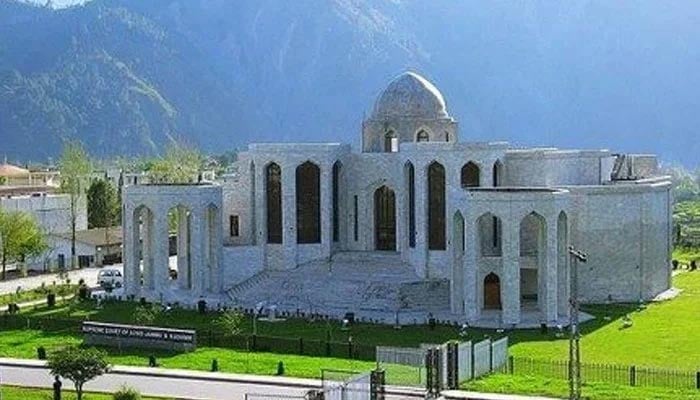
- Elections must be held on time: AJK Supreme Court
- Constitutional supremacy outweighs street agitation, says court.
- State responsible for maintaining order, electoral process: court.
MUZAFFARABAD: The Azad Jammu and Kashmir (AJK) Supreme Court on Sunday endorsed the government’s position on the issue of refugee seats, ruling that the 12 reserved refugee seats in the AJK Legislative Assembly enjoy constitutional protection and cannot be altered through an administrative decision.
The presidential reference had been filed by the President of Azad Jammu and Kashmir under Article 46-A of the Interim Constitution, 1974, on the advice of the government, seeking the court’s opinion on constitutional questions relating to refugee seats and other connected matters.
In its opinion, the apex court held that the 12 refugee seats derive constitutional protection under Article 22 and are rooted in historical legal arrangements dating back to the laws of 1960, 1964 and 1970. The court observed that the seats are also linked to the interim constitutional framework, the 1974 Constitution and the 1975 Act.
“Accordingly, we are of the considered opinion that the twelve refugee seats incorporated in Article 22(1)(a)(ii) and (ii) of the Constitution can be altered, reduced, or abolished only through a constitutional amendment enacted strictly in accordance with Article 33,” read the statement – a copy of which is available with Geo News.
“Any demand seeking abolition of any constitutional provision through coercion, brute force, threats of mass public obstruction, or other extra-constitutional means is devoid of constitutional sanction, legally unenforceable, and wholly incompatible with the principles of constitutional supremacy and the rule of law embodied in Articles 33 and 57 of the Constitution,” it added.
The court also endorsed the government’s decision to leave the remaining constitutional questions to the elected Legislative Assembly, stressing that constitutional amendments can only be enacted through public mandate, parliamentary debate and the prescribed constitutional procedure.
Interpreting Articles 22(3) and 22(4), the court clarified the powers and tenure of the Legislative Assembly and emphasised that elections must be conducted within the constitutional timeframe. It stated that political disputes or protests cannot be used as grounds to delay the electoral process.
The court further observed that the responsibility for conducting elections and maintaining law and order rests with the state, which is constitutionally bound to ensure the continuation of democratic and constitutional processes.
In its observation, the AJK SC said that the decisive force in Azad Kashmir is not street agitation but the supremacy of the Constitution. While recognising peaceful protest as a constitutional right, it noted that actions disrupting normal life do not enjoy constitutional protection.
The court also held that the exercise of one individual’s rights cannot become a justification for depriving other citizens of their rights. It stressed that the administration is obligated to preserve public peace, constitutional order and the rule of law.
The opinion comes amid the latest protest campaign that focuses on a demand to abolish the 12 seats in the Azad Jammu and Kashmir Legislative Assembly reserved for refugees from Indian Illegally Occupied Jammu and Kashmir (IIOJK) who migrated to Pakistan after 1947.
The All Parties Conference (APC) held at the Prime Minister’s Secretariat in Muzaffarabad this week rejected the demand for the abolition of 12 seats reserved for refugees residing in Pakistan in the Legislative Assembly and made it clear that constitutional reforms are the exclusive prerogative and mandate of elected representatives of the people.
A day ago, the AJK Legislative Assembly also passed a resolution retaining 12 seats reserved for Kashmiri refugees.
The resolution stated that refugee representation was a historical and constitutional reality. It added that any necessary reforms to remove electoral complications and make the system acceptable to political parties could be implemented through the assembly.