
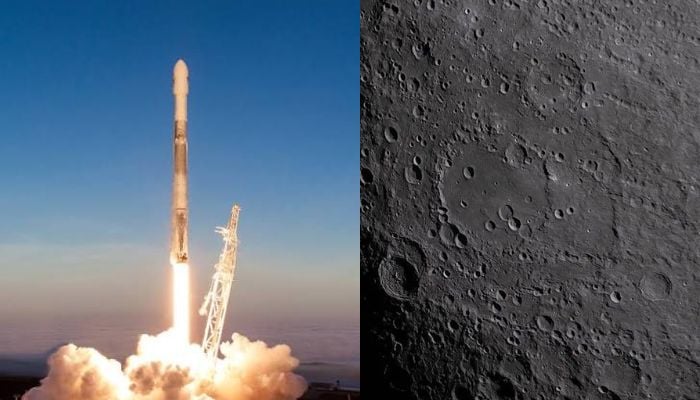
On Wednesday, the Moon is going to experience a collision as a drifting SpaceX rocket will smash itself to the lunar surface.
The upper section of a SpaceX Falcon 9 rocket is scheduled to impact the Moon on August 5 at approximately 02:35 EDT (06:35 GMT), according to Nasa’s Centre for Near-Earth Object Studies (CNEOS).
The drifting rocket debris is about the size of a five-storey building and weighs at least 4,000 kg and has been travelling at around 2.43 kilometers per second or about 5,400 mph.
According to the US space agency, the segment of the rocket from January launch 2025 was on an accidental collision course with the moon and it will land near the Einstein crater on the side of the Moon visible from Earth.
Speaking about the impacts of collision, spokesperson Jimi Russell clarified that there is no danger to earth.
“Nasa will continue to track the booster for training purposes, as well as later observe the impact site for scientific purposes,” Russell said.
Astronomer Bill Gray, who first discovered the trajectory, predicted the impact will create a crater over 17 m (56 ft) in diameter and send a dust plume 50 km or higher into the air.
According to Dr Matt Bothwell, public astronomer at the University of Cambridge, “It’s something really huge smashing into the Moon. It’s not remotely dangerous, we can just watch the show.”
“It’s going to impact and it’s going to send up a huge plume of dust, maybe 50km into the air or more, and that’s going to spread sideways over time,” Bothwell said.
According to astronomers, the impact will be more spectacular than any explosion on Earth due to lack of atmosphere and weaker gravitational pull on the lunar surface.
The collision will not be visible from Earth with the naked eye. Therefore, telescopes across the Americas, NASA’s Lunar Reconnaissance Orbiter, South Korea’s Danuri probe, and scientists will monitor the flash, plume, and resulting crater to study lunar impact models and subsurface material.
Bothwell mentioned the most concerning issue is the ever-accumulating and human-made space clutter, providing cautionary tale.
Bothwell added, “I think more people should be more worried about space debris. Every single year we put more stuff in orbit. Sometimes the satellites just collide, and they shatter into more pieces. I think there’s a worry about a runaway cascade, if we put so much stuff in orbit.”
According to the European Space Agency, about 54,000 objects larger than 10 cm currently float in space out of 17,000 tonnes of total objects launched since 1957.
Elon Musk’s SpaceX launched this rocket in 2025 as a part of Japanese and the US mission aimed at carrying lunar landers and scientific equipment to the moon.