
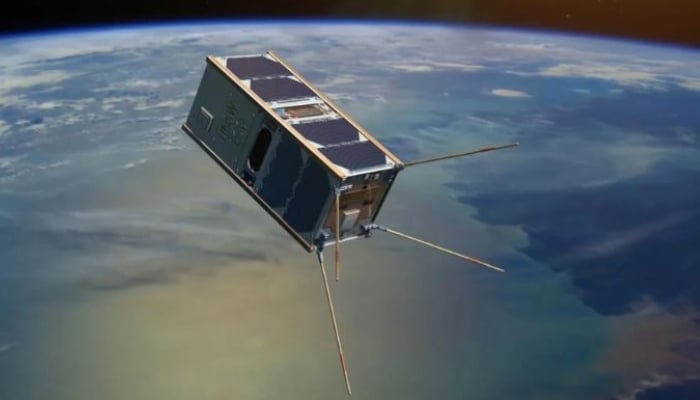
In contemporary times, nuclear supremacy is not just confined to Earth. Space is also becoming a part of this race.
In a recent breakthrough, an MIT scientist suggested a method to detect the possibility of nuclear weapons hidden in the satellite orbiting the Earth.
Areg Danagoulin, the mind behind the methodology, proposed a new sensor system designed to verify compliance with the 1967 Outer Space Treaty, which prohibits nuclear weapons in orbit.
This proposal carries a significant importance as currently there is no reliable and unclassified verification method.
In this methodology, the sensor system can detect neutrons generated by high-energy protons colliding with radioactive material, leading to the confirmation of nukes.
The device consists of pixelated neutron sensor panels sandwiched between neutrons originating from background radiation and nuclear material. For instance, if placed within 4000 meters of a suspect satellite, the system can detect the existence of nuclear weapons with 99 percent accuracy within one week.
But, if we reduce the distance or use multiple sensors, the efficiency of the device can be improved to just a few hours.
“I very much hope this will turn into a real system, or proof-of-concept system, but the goal right now is to get national labs to use this work for their own research and to get policymakers to seriously consider this technology as a potential part of national technical means,” Dr Danagoulian says in a study published in Nature.
While 118 countries have ratified the Outer Space Treaty, there is no established way to monitor whether a satellite is actually carrying a nuke.
The proposal shed light on concerns regarding Russia’s 2022 launch of Cosmos 2553 in a highly radioactive belt. As per experts, this would be an ideal place to trap electrons if nuclear devices were detonated.
In the case of detonation, the impact would be far-reaching, destroying global satellite infrastructure.
According to the lead author, the latest study didn’t provide a “completely proven system”. Instead, it reveals this methodology is scientifically feasible.
“But there are many more practical considerations to be made to actually build these detectors,” Dr Danagoulian said.