
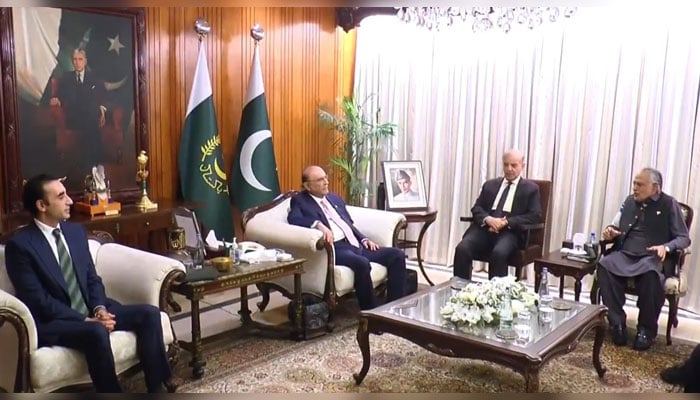
- Top leadership reviews security, economic and energy challenges.
- DPM Dar, Bilawal attend high-level meeting on regional situation.
- DPM Ishaq Dar set to visit China on March 31 for key talks.
ISLAMABAD: President Asif Ali Zardari and Prime Minister Shehbaz Sharif on Monday stressed the need for a cohesive national strategy and stronger institutional coordination to effectively address key challenges facing the country in the wake of the ongoing US-Israeli war on Iran.
The premier called on the president in Islamabad, where both leaders held detailed consultations on emerging national and regional challenges.
The meeting was attended by Deputy Prime Minister and Foreign Minister Ishaq Dar, former foreign minister Bilawal Bhutto Zardari, Interior Minister Mohsin Naqvi, and National Security Adviser Lieutenant General Asim Malik.
Participants exchanged views on the overall national security situation, with particular focus on the evolving regional environment and its implications for Pakistan. The discussion also covered pressing economic, energy and security challenges confronting the country.
The leadership emphasised the need to adopt a national-level strategy with enhanced institutional coordination to effectively respond to these challenges.
The meeting followed a quadrilateral conference hosted by Islamabad, bringing together the foreign ministers of Pakistan, Saudi Arabia, Turkiye and Egypt to explore ways to de-escalate the Iran conflict.
Pakistan has emerged as a key facilitator between Iran and the United States, serving as an intermediary for messages between the two sides as the war continues.
Sunday talks were attended by Saudi Foreign Minister Prince Faisal bin Farhan, Turkish Foreign Minister Hakan Fidan, and Egyptian Foreign Minister Badr Abdelatty, as Pakistan stepped up diplomatic efforts to help ease tensions in the Middle East.
These efforts come amid attempts to create space for negotiations to end the more than month-long war involving the United States, Israel and Iran, which began on February 28 and has had far-reaching implications across the region.
The conflict has also triggered significant economic repercussions, with disruptions to oil and gas shipments through the Strait of Hormuz exerting pressure on global markets.
Meanwhile, DPM Dar is set to visit China on March 31 (Tuesday) for in-depth discussions on regional developments, as well as bilateral and global issues of mutual interest, according to the Foreign Office.