
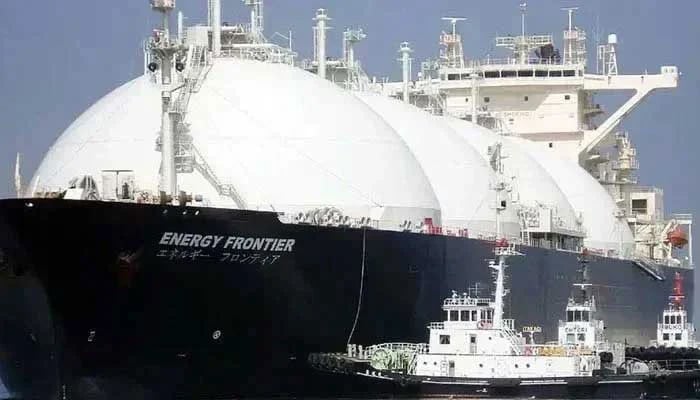
- Senate panel briefed on fuel shortages and rising prices.
- “Gas demand in power sector won’t be fully met in April.”
- Alternative sources will be used to bridge shortfall: officials.
ISLAMABAD: Liquefied natural gas (LNG) will no longer be available in Pakistan after April 14 due to supply disruptions linked to tensions in the Middle East, a Senate panel was told on Monday.
The meeting of Senate Standing Committee on Petroleum, chaired by Senator Manzoor Ahmed, was informed that LNG imports from Qatar had been completely suspended since March 2, raising concerns about gas availability for the power sector in the coming weeks.
The Middle East conflict threatens LNG shipments from Qatar, the world’s second-largest LNG exporter after the United States, which supplies the bulk of Pakistan’s imported LNG used to power electricity plants during peak demand.
Shipping through the narrow waterway has nearly come to a halt since the start of the US-Israeli war on Iran. The disruption has blocked the export of around one-fifth of the world’s oil supply and liquefied natural gas, pushing global oil prices to levels not seen since 2022.
The global price hike also led to the federal government raising petrol and diesel prices by Rs55 per litre as surging international prices, fuelled by the US-Israel war with Iran, put pressure on domestic energy costs.
During today’s briefing, the Ministry of Petroleum officials said Pakistan had two LNG supply agreements with Qatar, but shipments had been affected amid the ongoing regional conflict. Out of eight cargoes scheduled for March, only two arrived, while six cargoes expected in April are unlikely to reach the country.
As a result, officials warned that LNG would not be available in the country after April 14, adding that gas demand in the power sector would not be fully met in April.
They said alternative sources would be used to bridge the shortfall, including the possibility of purchasing LNG from Azerbaijan, although spot purchases could cost around $24 per unit compared with $9 under the Qatari contract, potentially leading to more expensive electricity generation.
The committee was also told that Sui Southern Gas Company had reduced gas supply by 50% to one fertiliser plant, while gas supply to the power sector had fallen from 300 mmcfd to 130 mmcfd. Officials assured the committee that domestic consumers would continue to receive a gas supply.
Secretary Petroleum Mirza Nasir-ud-Din Ahmad informed the panel that the supply of petroleum products had been affected by the escalating tensions in the Middle East, noting that around 70% of Pakistan’s petroleum imports originate from the region.
He added that shipping movement had been disrupted, affecting deliveries.
The secretary said global fuel prices had surged, with high-speed diesel rising from $88 per barrel to $187 per barrel, while petrol prices had increased from $74 per barrel to $130 per barrel.
Meanwhile, Senator Manzoor Ahmed questioned the government’s decision to raise fuel prices when reserves for up to 28 days were available, while Senator Saadia Abbasi alleged that the government had benefited by increasing prices on existing stock.
However, the secretary said petroleum products remained available across the country as imports continued despite the price surge, adding that the recent increase in domestic fuel prices was aimed at discouraging hoarding and ensuring uninterrupted supply.
He pointed out that Pakistan currently has crude oil reserves sufficient for 11 days, diesel stocks for 21 days, petrol reserves for 27 days, LPG stocks for nine days, and JP-1 aviation fuel reserves for 14 days, the committee was told.
Responding to the concerns, the secretary said the move did not benefit oil marketing companies, as the price adjustments helped maintain imports and ensured the availability of petroleum products nationwide.
According to the Oil and Gas Regulatory Authority (Ogra), diesel prices have increased by about 100% and petrol prices by around 70% since March 7.
The secretary said the government was also working on a relief package for motorcycle and rickshaw users, adding that measures had been taken to promote savings and provide relief to the public.
He further said efforts were underway to increase the utilisation of existing fuel reserves, while the government had temporarily allowed imports of oil below the Euro-5 quality standard to ease supply pressures.
The committee was informed that a ministerial committee formed by the prime minister reviews the petroleum supply situation on a daily basis.
Officials added that petroleum imports were continuing, noting that India had also been affected, with about 60% of its petrol imports disrupted due to the regional crisis.
Earlier, Energy Minister Awais Leghari said Pakistan’s growing reliance on domestic energy sources — including solar, wind, nuclear, coal and hydropower — has reduced the country’s exposure to global LNG supply disruptions.
Pakistan cancelled 21 LNG cargoes due in 2026-27 under a long-term deal with Italy’s Eni as domestic power and solar growth cut gas demand.