
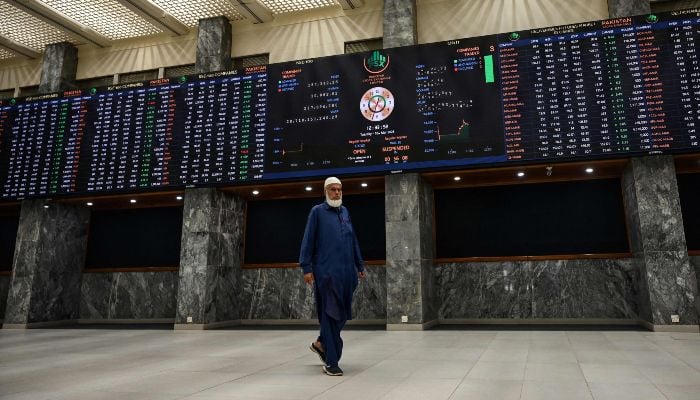
Equities traded mixed on Thursday as a surge in global oil prices weighed on risk appetite, while optimism around Pakistan’s progress toward a staff-level agreement with the International Monetary Fund (IMF) helped limit the downside.
The index traded between a high of 157,080.28 (up 1,221.81 points, or 0.78%) and a low of 153,503.70 (down 2,354.77 points, or 1.51%) versus the previous close of 155,858.47.
“The market showed mixed reactions during the session as rising international oil prices weighed on sentiment, while optimism surrounding Pakistan’s progress in negotiations with the IMF provided some support to investor confidence,” Huzaifa Riaz, Director, Mayari Securities (Pvt) Limited, told Geo.tv.
“Going forward, investors will keep a close eye on developments between the United States and Iran, with any signs of an off-ramp being positive for equities,” he added.
Shares across Asia fell as oil leapt 9% above $100 a barrel on reports of more ships being hit in Gulf waters and the closure of oil terminals, stoking fears of higher inflation and borrowing costs. Brent rose to $100.22 a barrel and US crude to $95.41, while MSCI’s broadest Asia-Pacific index outside Japan fell 1.6% and Japan’s Nikkei dropped 1.5%. S&P 500 and Nasdaq futures were down 1%.
The International Energy Agency’s plan to release 400 million barrels from reserves, including a 172 million-barrel US release starting next week, did little to calm markets. Iraqi officials said two fuel tankers had been struck by explosive-laden Iranian boats, while Iraq’s oil ports “have completely stopped operations,” according to state media.
Pakistan and the IMF are nearing consensus on a revised macroeconomic and fiscal framework under the $7 billion Extended Fund Facility (EFF), with the Federal Board of Revenue (FBR) tax collection target expected to be revised down again to Rs13.45 trillion by end-June 2026, The News reported.
The FBR has faced a Rs428 billion shortfall against the revised target in the first eight months of FY26, and the tax-to-GDP ratio is now projected at 10.6% by June 2026 versus 10.3% achieved by June 2025. CPI-based inflation is projected around 7%–7.5% for the current fiscal year, according to the revised framework discussed in the talks.
“Stocks showed positive activity in the early session at PSX amid institutional support on higher remittances, easing fuel supply fears on timely reserve buildup and SBP status quo in the policy announcement last week,” said Ahsan Mehanti, Managing Director and CEO of Arif Habib Commodities.
“Higher global crude oil prices, expected release of IMF tranche this month and upbeat economic data played catalyst role in positive activity at PSX,” he further added.
The United Arab Emirates (UAE) emerged as the largest source of remittances in February, with overseas Pakistanis sending about $696 million, overtaking inflows from Saudi Arabia at about $685.5 million, according to the State Bank of Pakistan (SBP).
Overall remittances stood at $3.29 billion in February, compared with $3.46 billion in January, but were 5.2% higher year-on-year, the central bank said. Within the UAE, most inflows came from Dubai ($566 million), followed by Abu Dhabi ($102 million) and Sharjah ($12 million).
After the UAE and Saudi Arabia, the largest inflows came from the United Kingdom ($532 million) and the United States ($319 million), while other Gulf countries, including Qatar, Kuwait, Oman and Bahrain, together contributed about $317 million.
In the previous session on Wednesday, the KSE-100 closed at 155,858.47, down 318.65 points (-0.2%) from 156,177.12, after trading between 158,624.51 and 155,652.35.